
Life in a Day
100 Miglia del Monviso - July 2025 - 24h 26' - 3rd classified

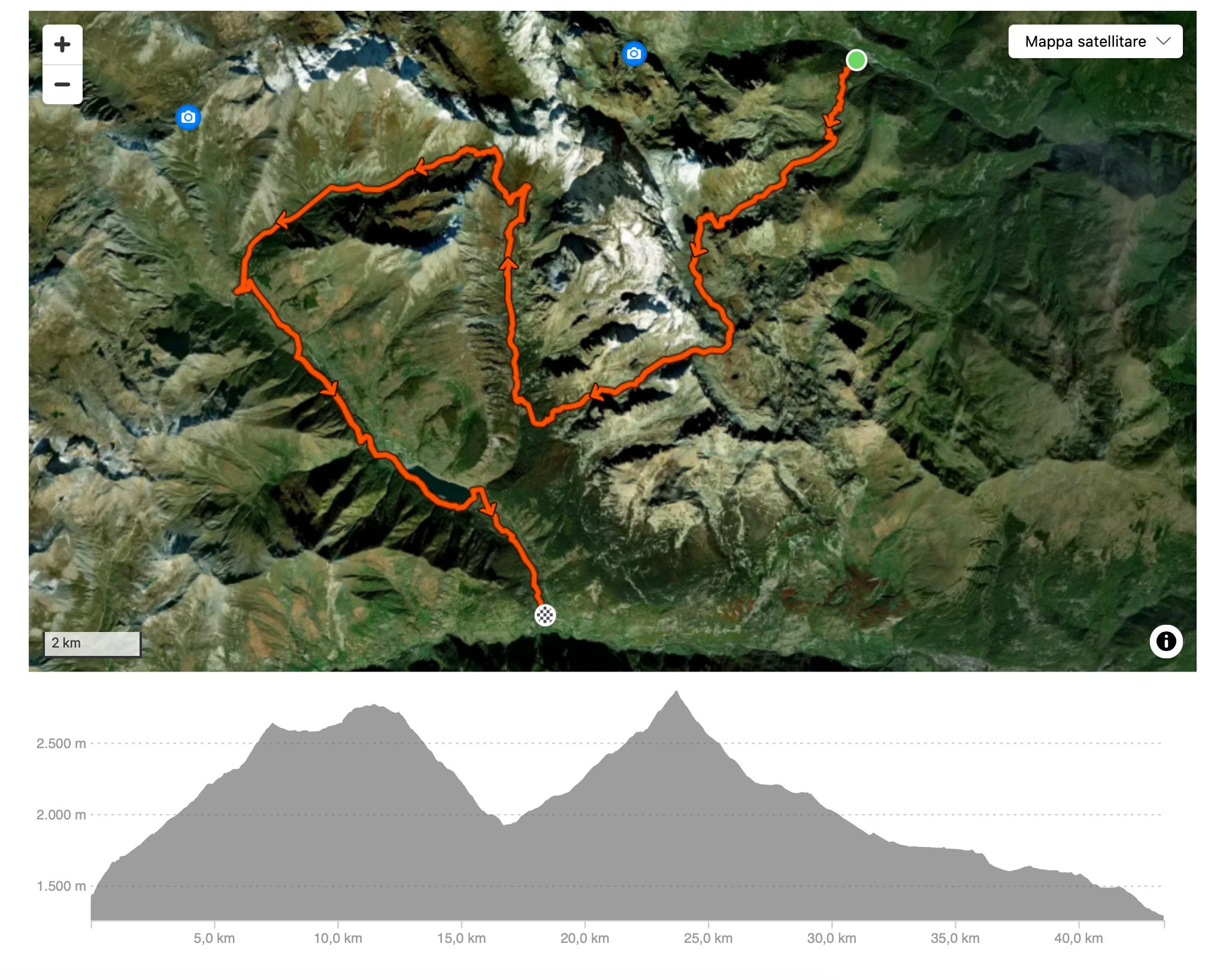
The forests of the first night, dotted with hamlets brought to life by volunteers and locals cheering you on at the aid stations. The high mountains around Monviso, something you have to see in order to truly understand. The mental and physical challenge of heading back toward the plains with forty kilometers of unbroken descent, followed by just as many winding ups and downs through the hills at the bottom of the valley.
What to listen to 🎼
I saw this race being born
I was at the start on that hot afternoon of a strange summer, the 2020 one, when a handful of adventurers - together with some big names like Franco Collè, Marco De Gasperi, and Paolo Bert - were about to run the edition number zero of what was then a visionary attempt to bring the queen distance of ultras into the wild Alpi Cozie.
One hundred miles are typically an American challenge: a symbolic distance made famous by a few historic races that were later reinvented in many forms all over the world. In Europe, technical races have taken hold, winding across the Alps - more demanding in their terrain than their overseas sisters, which are fast and runnable.
For those who want to dig deeper into the history of trail and ultrarunning in Italy, I highly recommend Pionieri, a true goldmine.
The 100 Miglia del Monviso (100MM) was born riding a wave, but perhaps no one - not even the race itself - has ever truly understood its real nature.
Over the years, this race has struggled to capture the hearts of Italian trail runners, who are used to routes that stay higher up in the mountains. Starting from the valley floor doesn’t seem to appeal; running so many kilometers on dirt roads and tracks, through the hot summer nights, often leaves participants disappointed.
“They should start it from Crissolo,” they say. “Keep it higher.”
Maybe I never saw it as a mountain race. I never compared it to UTMB, LUT, or TOR, as so many do.
These courses shouldn’t be compared. They should be studied and experienced in their uniqueness, and I believe the 100MM has a strong, authentic personality of its own. Not a poor imitation of some bigger sister, but an entity in itself, with its own logic of a gigantic out-and-back: to Monviso and back, a dream.
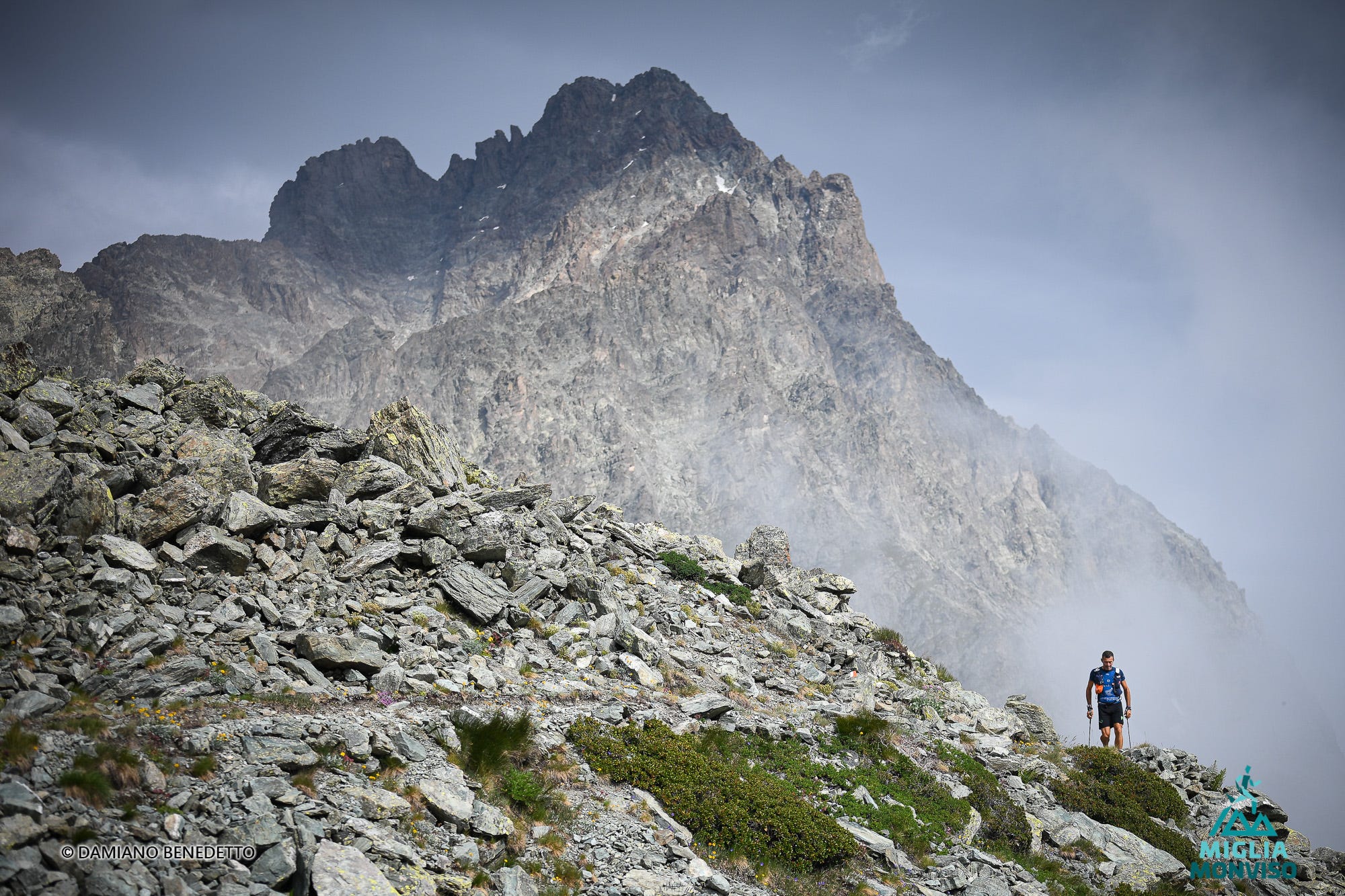
For obvious reasons, the race does not reach the summit of the so colled “Stone King,” but it circumnavigates it, offering breathtaking landscapes, moving even for me, though I’ve seen them so many times before.
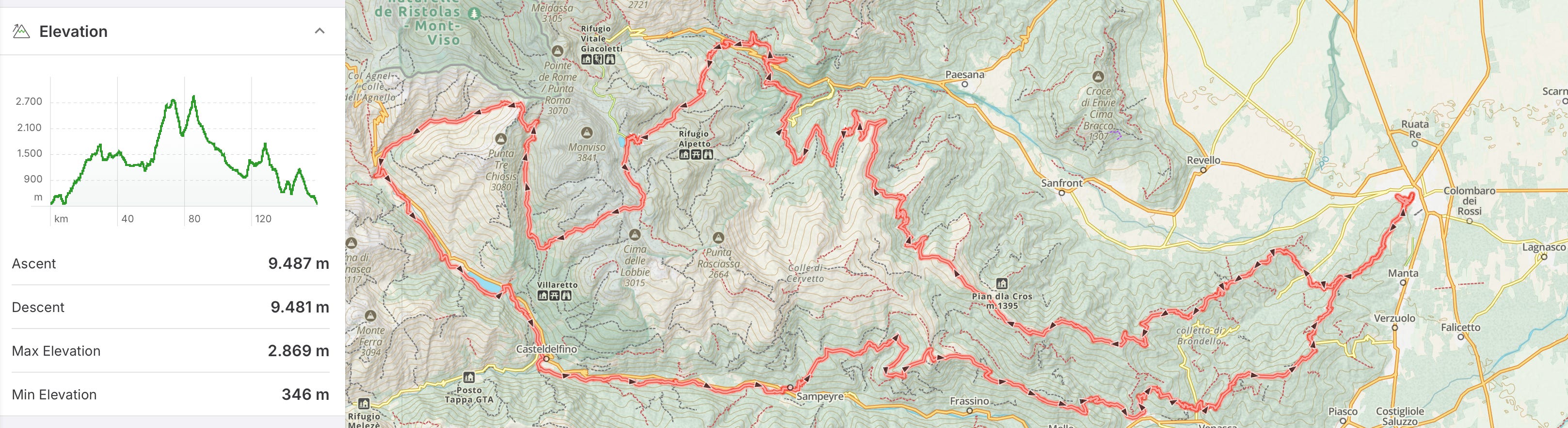
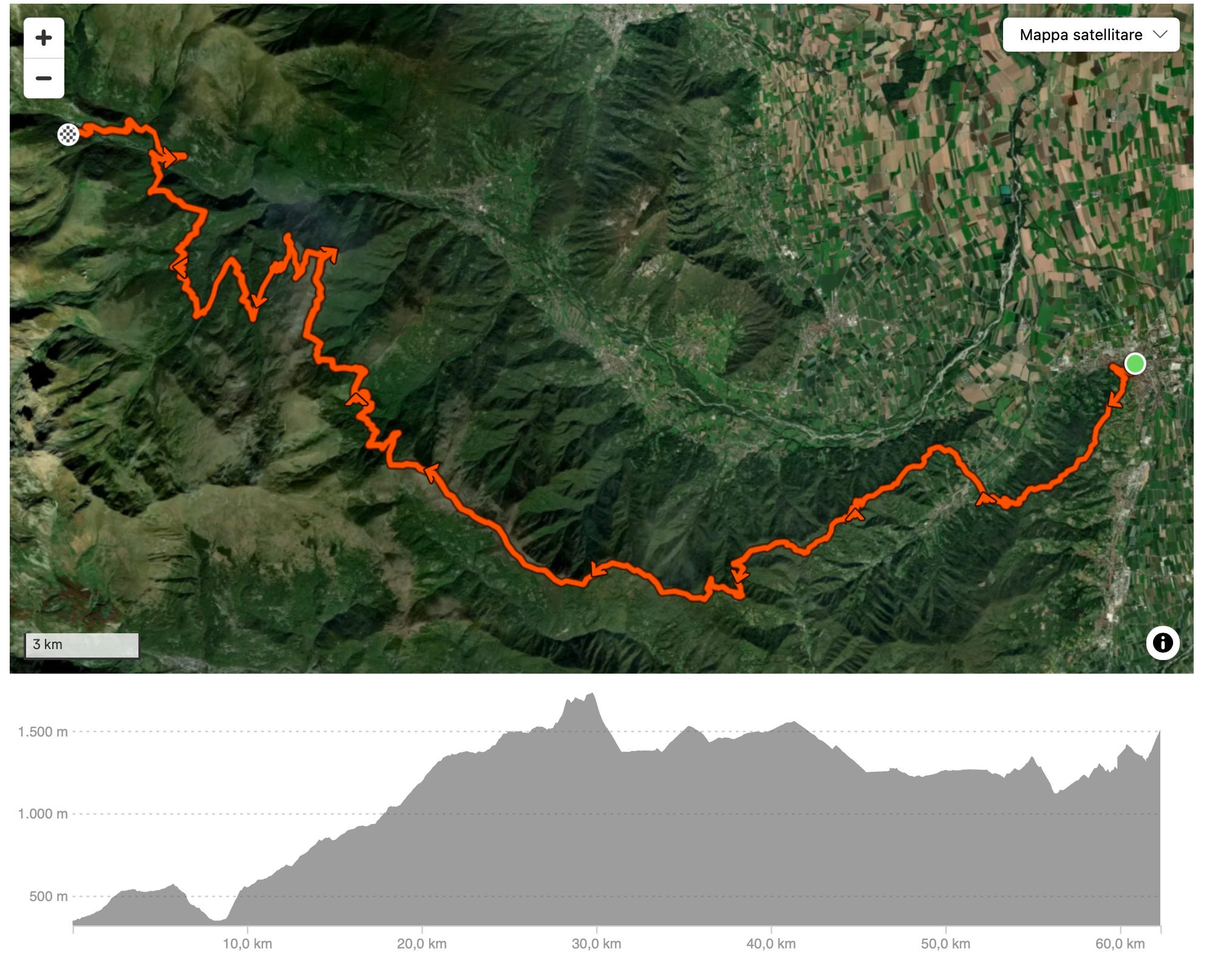
The course is what enchanted me from the very beginning
A perfect blend of European and American style races, with fast, flowing sections broken up by a stretch of high mountain rugged and demanding terrain around Monviso: three segments that require different skills and approaches. This makes the competition potentially very intense, rewarding pure runners at times and the toughest mountain athletes at others.
In 2021 I ran and finished this race, fulfilling a dream—but at a very high price: a knee injury (first picked up two months earlier at the Italian mountain running relay championships and inevitably worsened here) and 34 sleepless hours to complete the loop.
In 2024, after two years of gathering experience, I lined up with a completely different preparation. But I dropped out halfway, stomach issues keeping me from eating for five hours. That day my mind decided it wasn’t the right moment, yet the speed at which I bounced back in the following week convinced me I had been physically ready.
Another year goes by, and here I am again, lying on my bed with my legs raised, killing time as I wait for 9:00 p.m. - start time.
.
In the town square I’m relaxed. Racing at home means friends, family, and familiar faces at every corner, ready to clap me on the shoulder, wish me good luck, give their warnings, or hug me tight. I wander among the tense yet happy expressions of the other runners. I’m ready to start.
SALUZZO - CRISSOLO . Ordeal
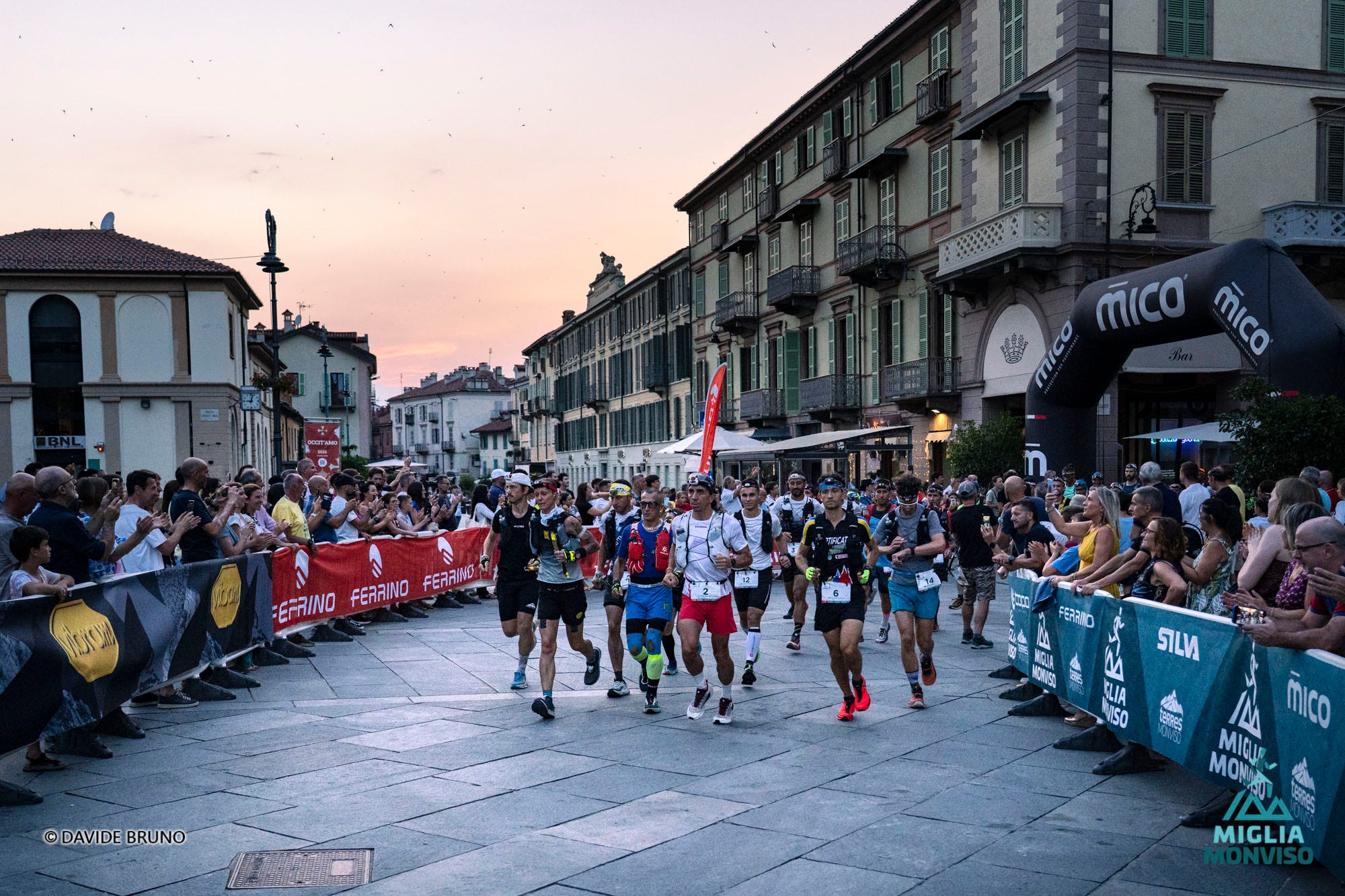
It’s a long race. We start with awareness, nobody pushing the pace; since I like to have a clear trail on the downhills, I find myself at the front of the group after about five kilometers, with only one runner breaking away immediately after the start. He won’t get far.
After Castellar the group bunches up again on the second climb. Night falls, and the energy of the start gives way to a fake quiet on the surface, charged with tension underneath. On the first of many wide dirt roads, we go around making introductions, and the early miles slip by lightly.
Past San Bernardo di Gilba, I find myself leading again on the climb toward Bric la Costa. No surge, just me settling into my own rhythm. The cool air along the ridge betrays me, and after Pian Pilun the unexpected happens. Diarrhea. At Pian Muné things seem under control, but in the next fifteen kilometers I’m forced to stop six or seven times.
I drop into seventh place as we pass through Borgata Serre and Oncino. Morale stays high—the sky full of stars, the perfect temperature, so many kilometers still to run, just the way I like it. I’ve had to cut back on intake and ease off the pace, but I move forward with confidence.
In my headphones, OneRepublic reminds me that if love is pain, then tonight let’s hurt together.
In races like this - very long ones - you have to eat constantly to avoid running out of energy later. To limit stomach issues at this stage I try to take in more solid food (most of my calories come from water and sugars, about a thousand calories per bottle every three hours), but I force myself to swallow whatever I can, just to keep from falling behind on calories. The body has some autonomy, but if you run into a “fuel reserve” problem, the risk is hitting the wall and never recovering.
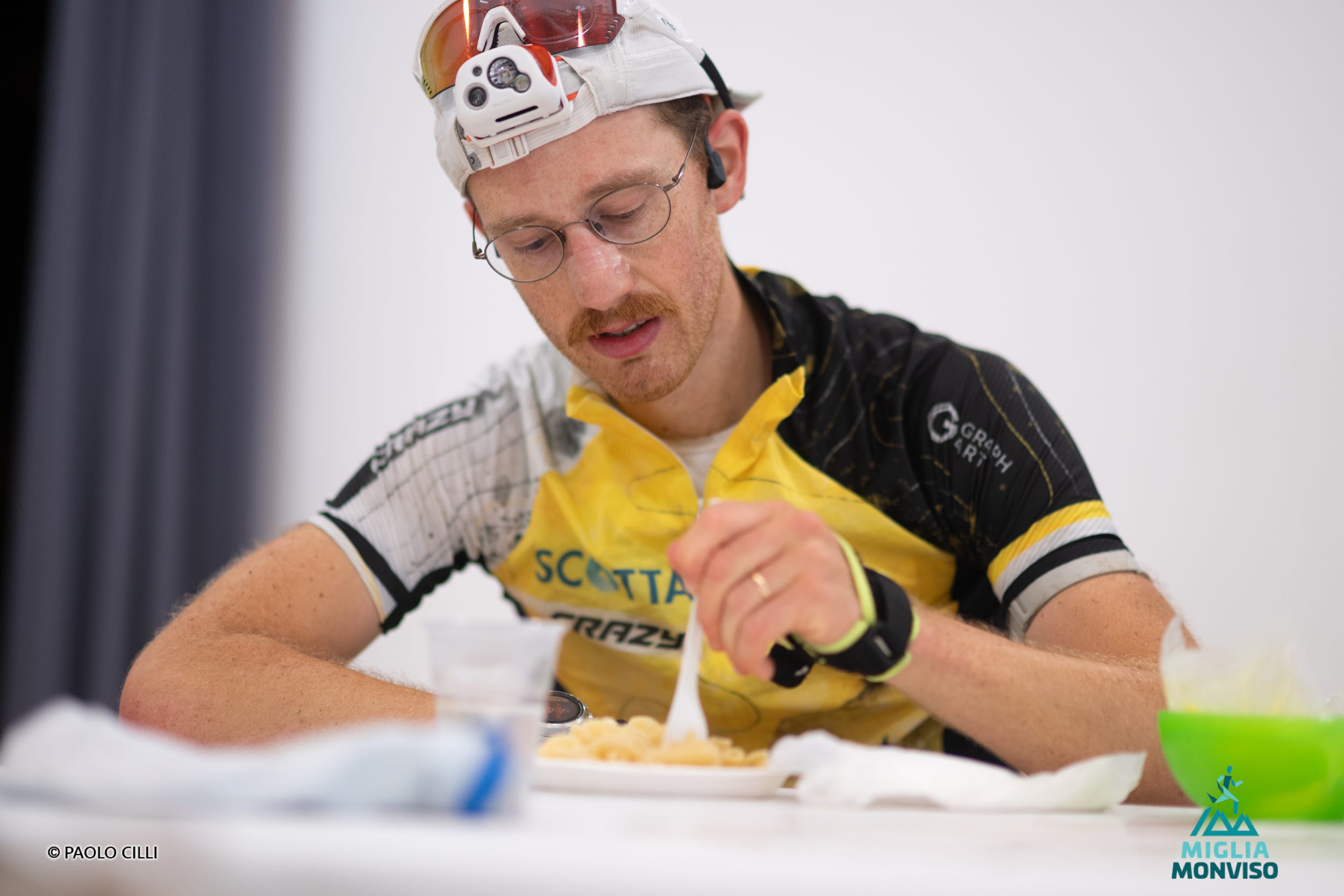
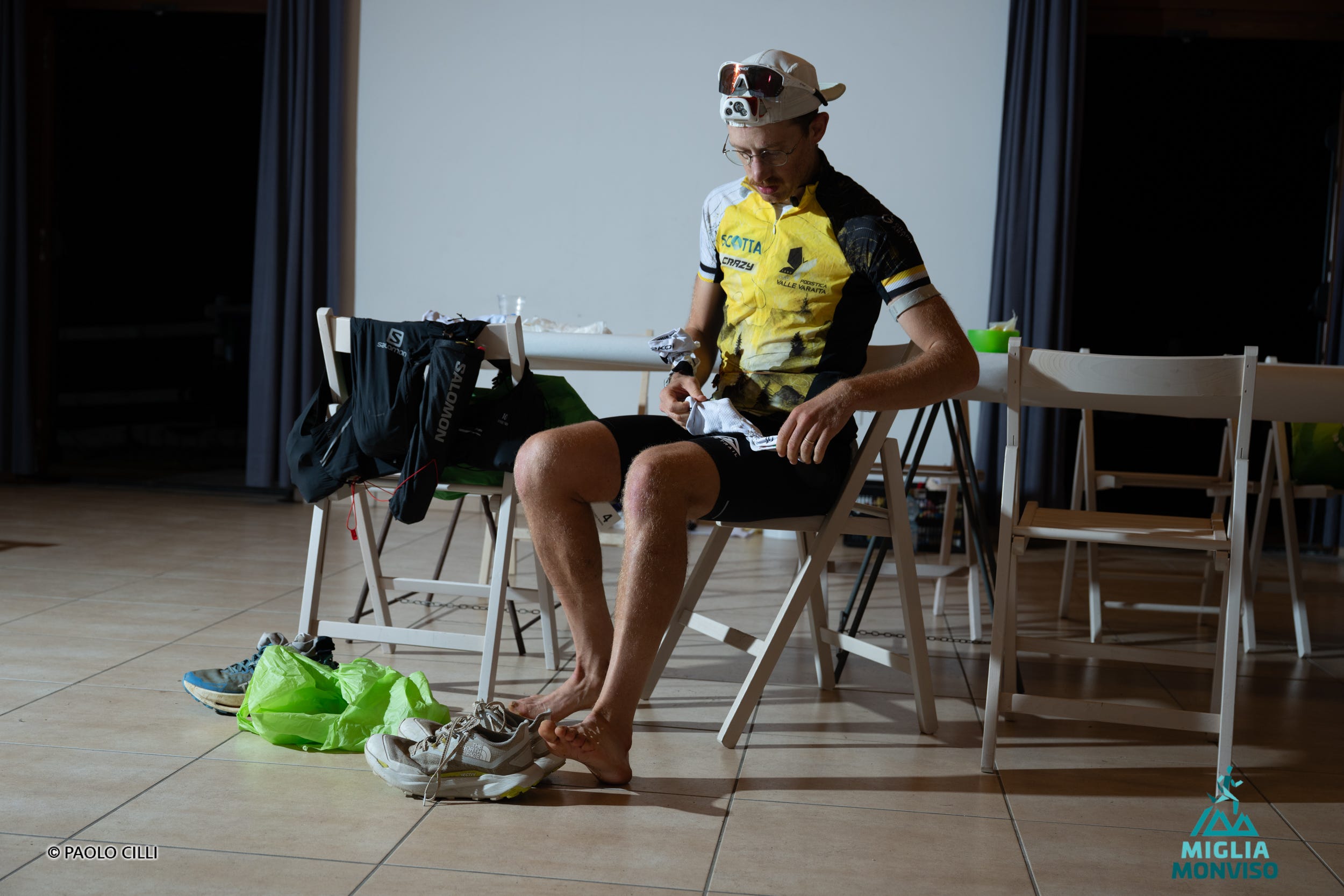
Ostana comes and goes, and then finally Crissolo. I change shoes and shirt, eat half a plate of pasta, and hit reset mentally. A new day begins.
CRISSOLO - CASTELDELFINO . Paradise
The climb up to Quintino Sella is a beast: eight kilometers with 1,300 meters of elevation gain. I break it down in my mind into three sections: the long straight stretch beneath the ski lifts, the gentler slopes through the pastures, and finally the Balze di Cesare - the last, brutal sting in the tail.
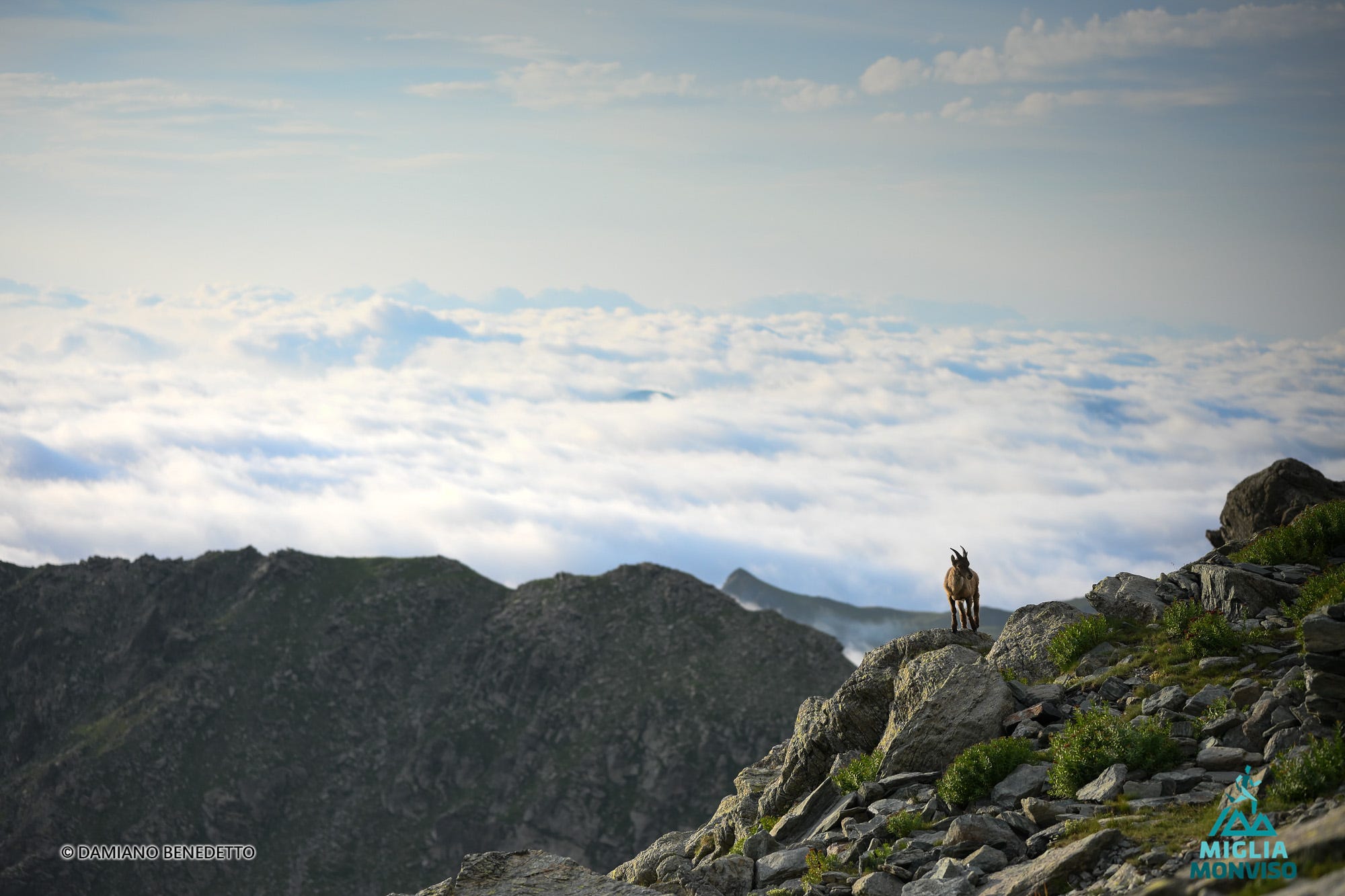
I cover the entire ascent alongside Mattia, bib number 5, a guy from Bergamo, also new to this distance. As we climb, we leave the clouds behind, and in front of us unfolds the majestic spectacle of Monviso, surrounded by its crown of jagged peaks. The sun paints the rock in shades of pink as it rises above the green meadows and the blue sky. Paradise.
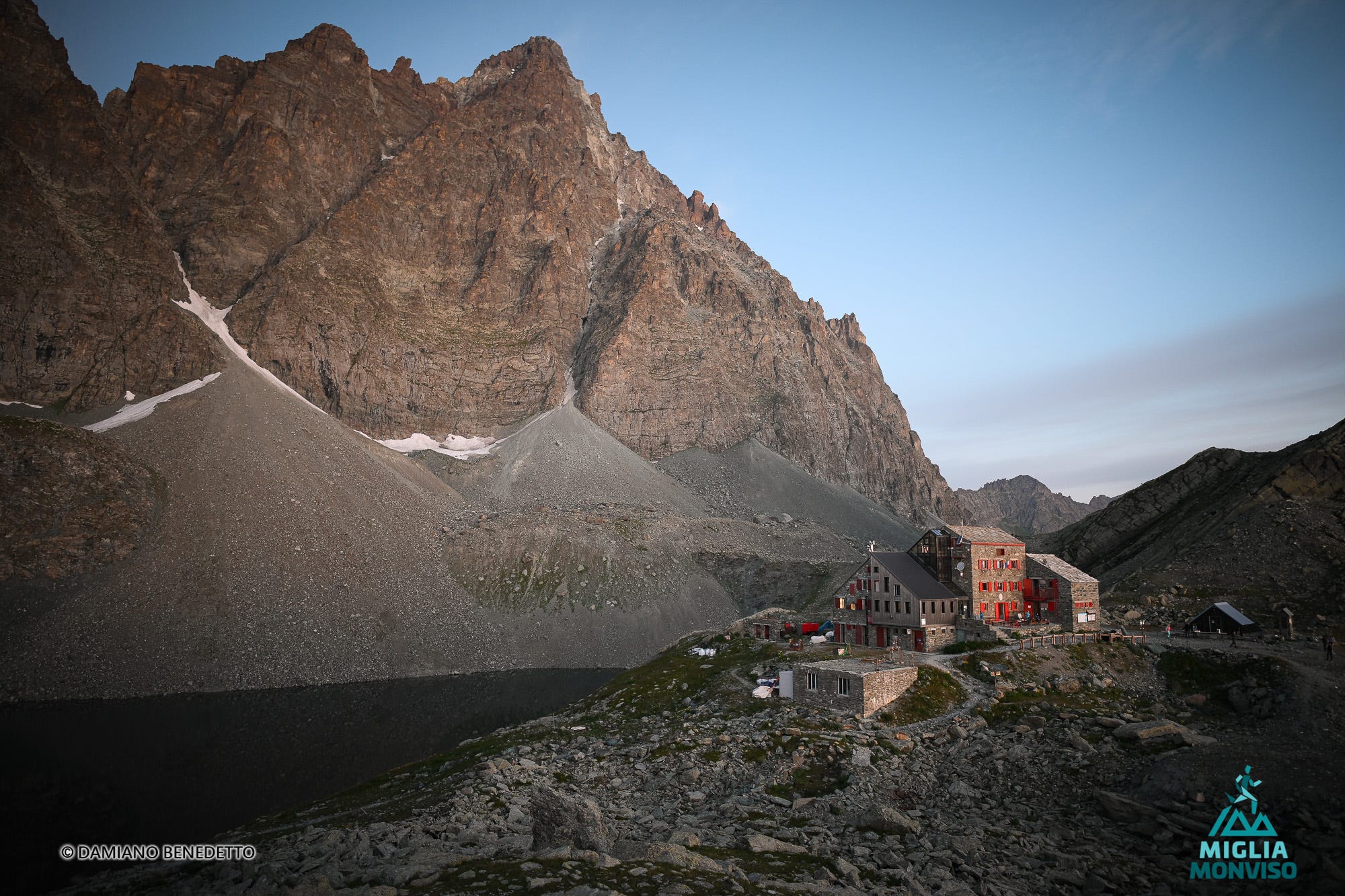
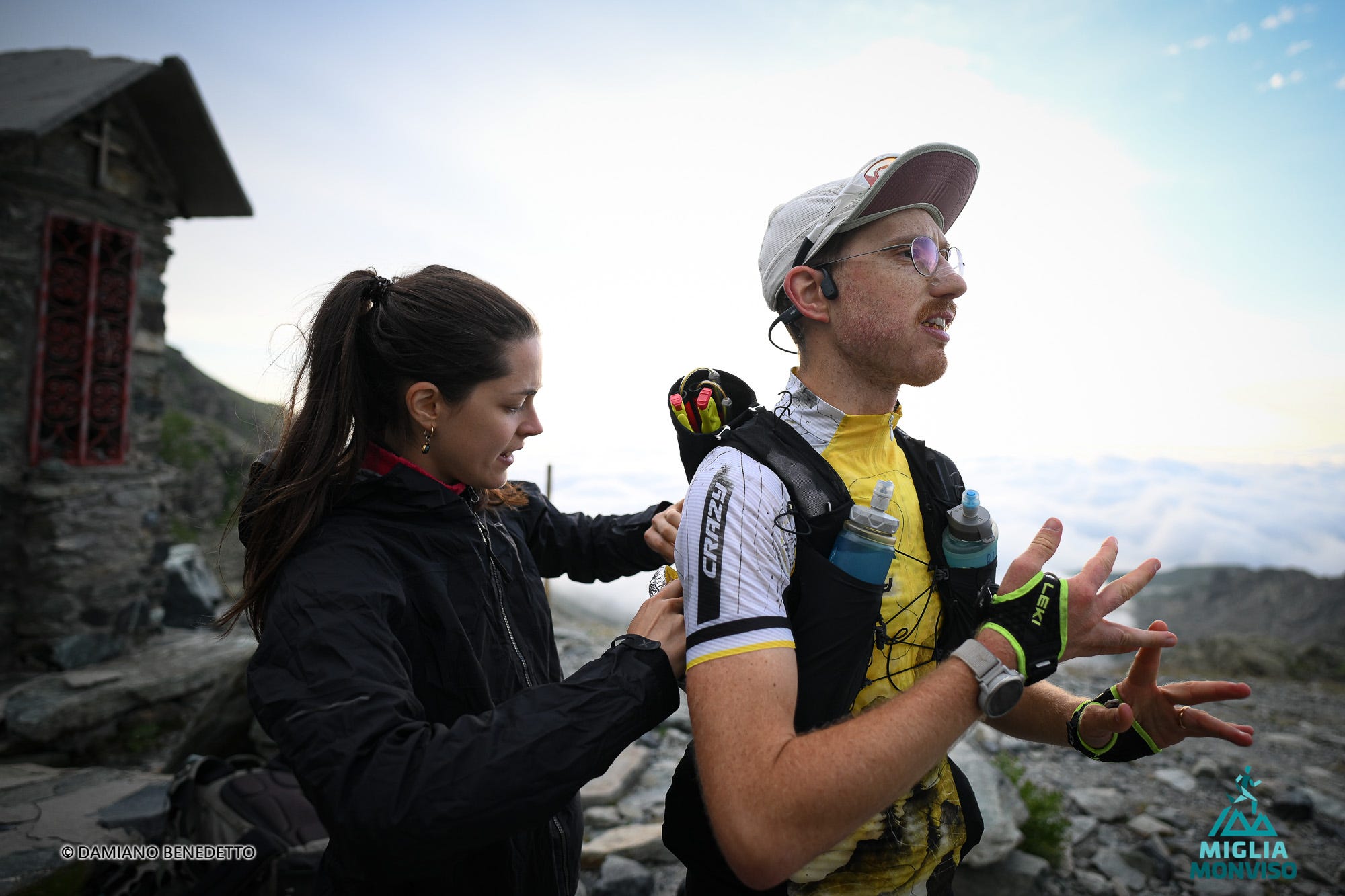
I think of Giulia, whom I haven’t seen since Pian Muné. At 4:00 a.m. she left Crissolo to wait for me at the top of the climb, at the Quintino aid station. And then, finally, I reach her. We greet each other good morning, quickly share stories of the night, while she helps me load my pack with the calories that will carry me to Casteldelfino, thirty-five kilometers ahead.
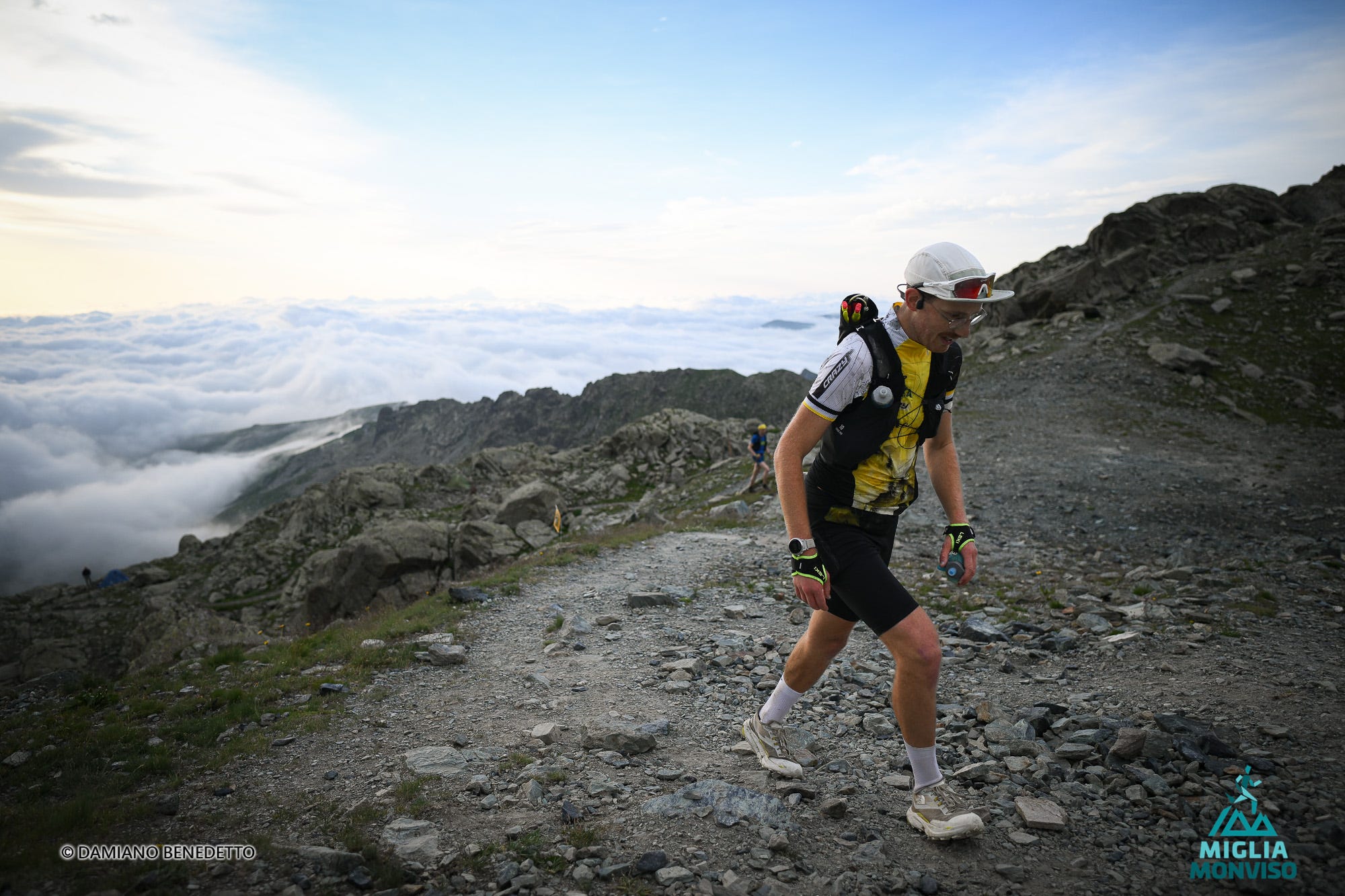
Running up here is an unmatched spectacle - stone everywhere, a small lake down to the left, Monviso towering just off to the right.
I’m flying.
There are still two of us, and bib number 3 - Napoleone - wich pushes hard on the climb, but on the descent after San Chiaffredo Pass he fades behind us.
At Pian Meier I meet Piero for the first time today, teammate and training partner, who will pace me through the final sixty kilometers of the race. He’s come up with my father to check on me at Grange Gheit, the point that marks the end of the toughest descent and the start of the hardest climb, leading us all the way to 2,900 meters at Losetta Pass.
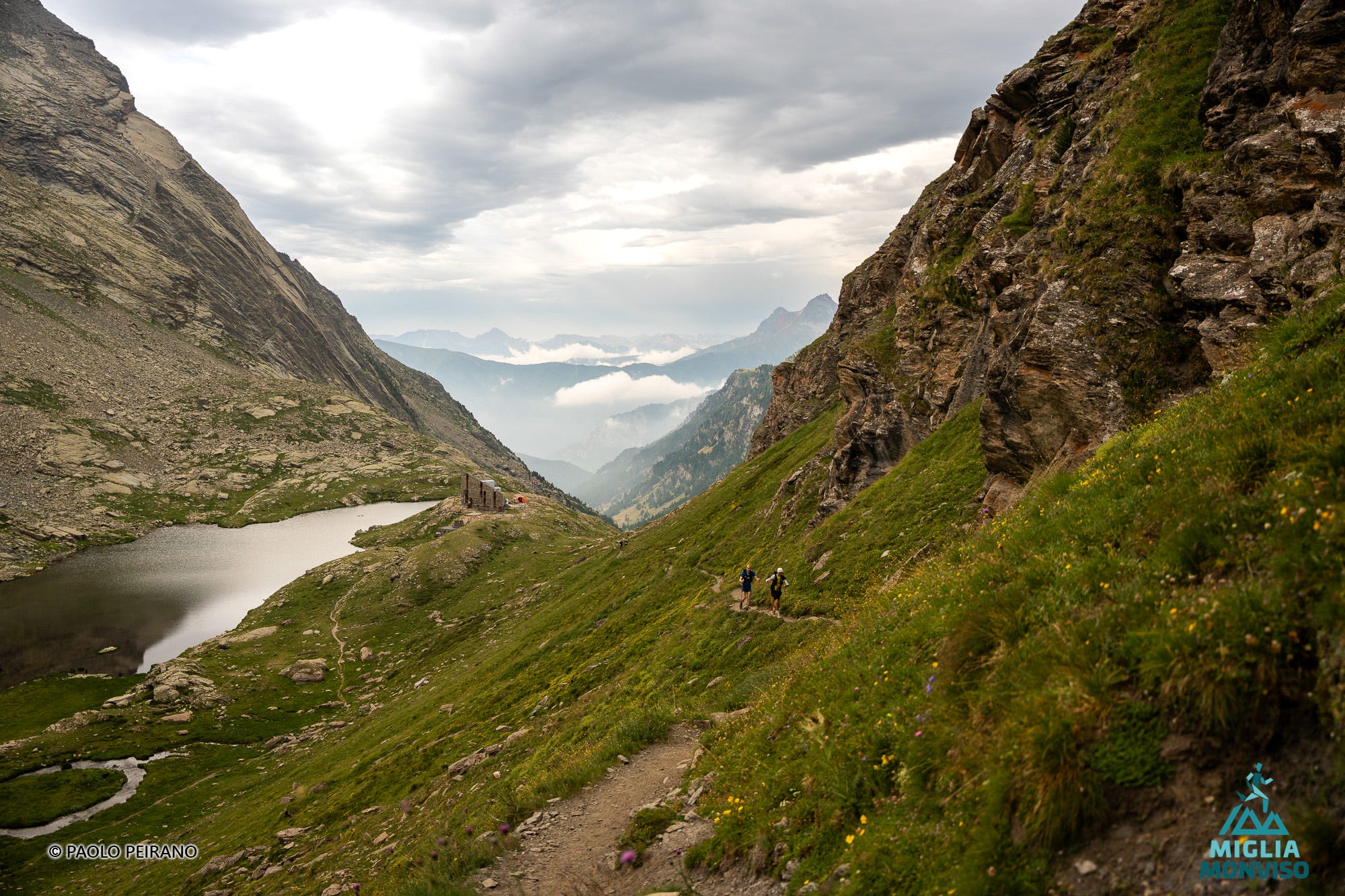
Here comes the first major crisis. I’m hit by a hollow emptiness in my stomach that feels impossible to fill. I choke down a peanut butter and jam sandwich, hoping it isn’t too late, and at the Vallanta aid station I take hot broth, trying to get things moving again. From there, the final 500 meters of climbing are a journey into the infernal depths of fatigue. I dig for whatever scraps of energy remain, ignoring the trail ahead, fully aware that step by step, sooner or later, the ascent will end.
One step at a time. Ever higher, ever deeper.
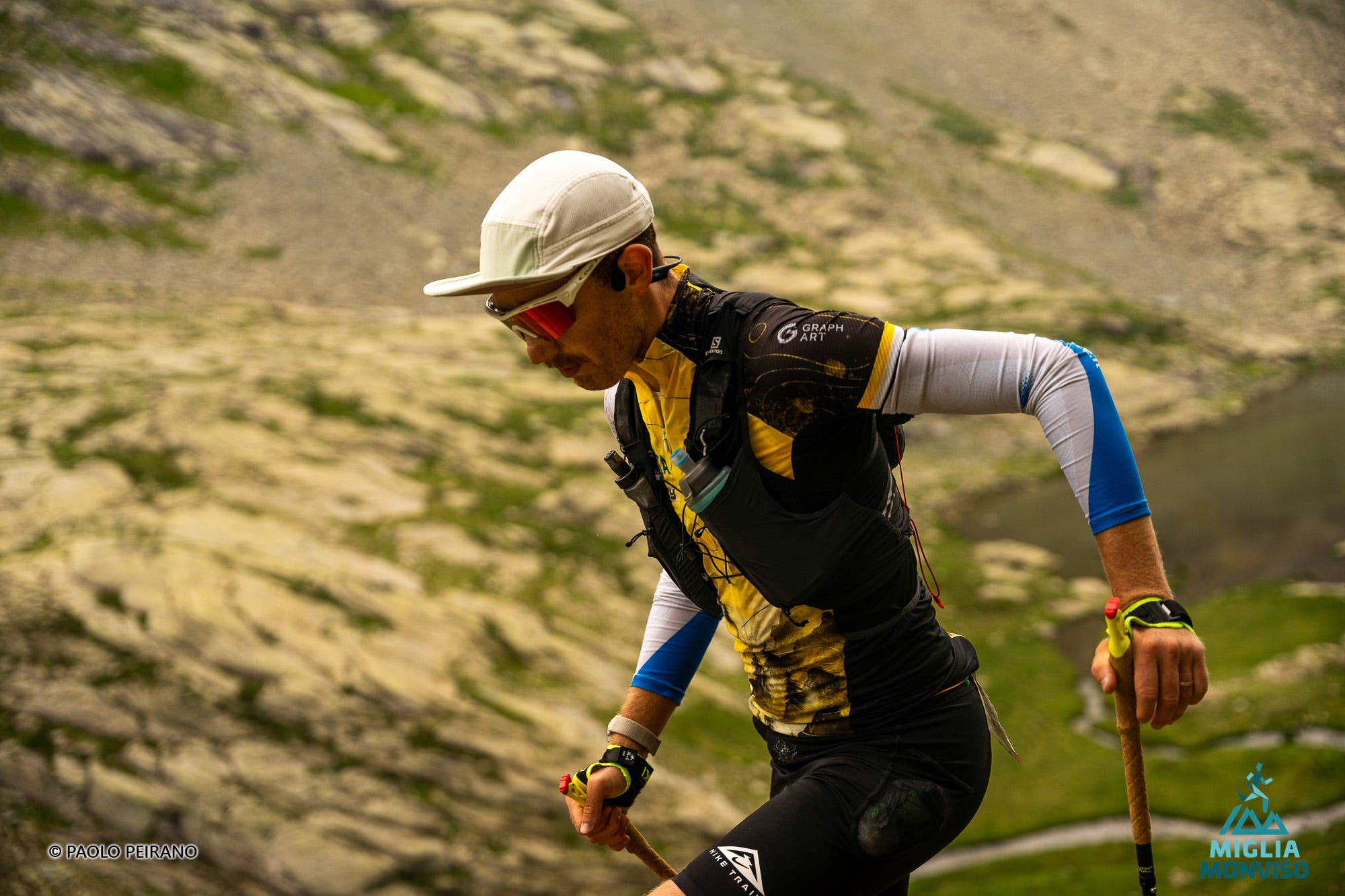
Napoleone and another runner, once again appearing out of nowhere, pass us - tired themselves, but moving faster. They pull away. Mattia chooses to stay with me.
We’re at the halfway point, 6th and 7th in the standings.
Almost unbelievably, I reach the mountain pass. The sky has clouded over, and a fine drizzle begins to fall.
We descend the wide Soustra valley. Little by little I regain clarity, emerging from the cave and returning to an appreciation of the outside world. Almost like a metaphor, the heavy clouds part for a while to let the sun through.
At the head of the Soustra trail, which leads us onto the paved road toward Colle dell’Agnello, I find Piero, my parents, and some friends cheering for me. Now I’m in Valle Varaita - home.
Crossing this long high-altitude stretch unlocks something inside me, after last year’s withdrawal. We head down toward the Casteldelfino life base at a good pace, moving back into 4th and 5th place. Chianale, Pontechianale, Castello. Every two or three kilometers a familiar face cheering, calling out my name.
—“Are they all here for you?” Mattia asks, surprised by how many people recognize me.
—“Not all of them,” I reply, “but it’s a small valley - we all know each other.”
CASTELDELFINO - SALUZZO . Hell
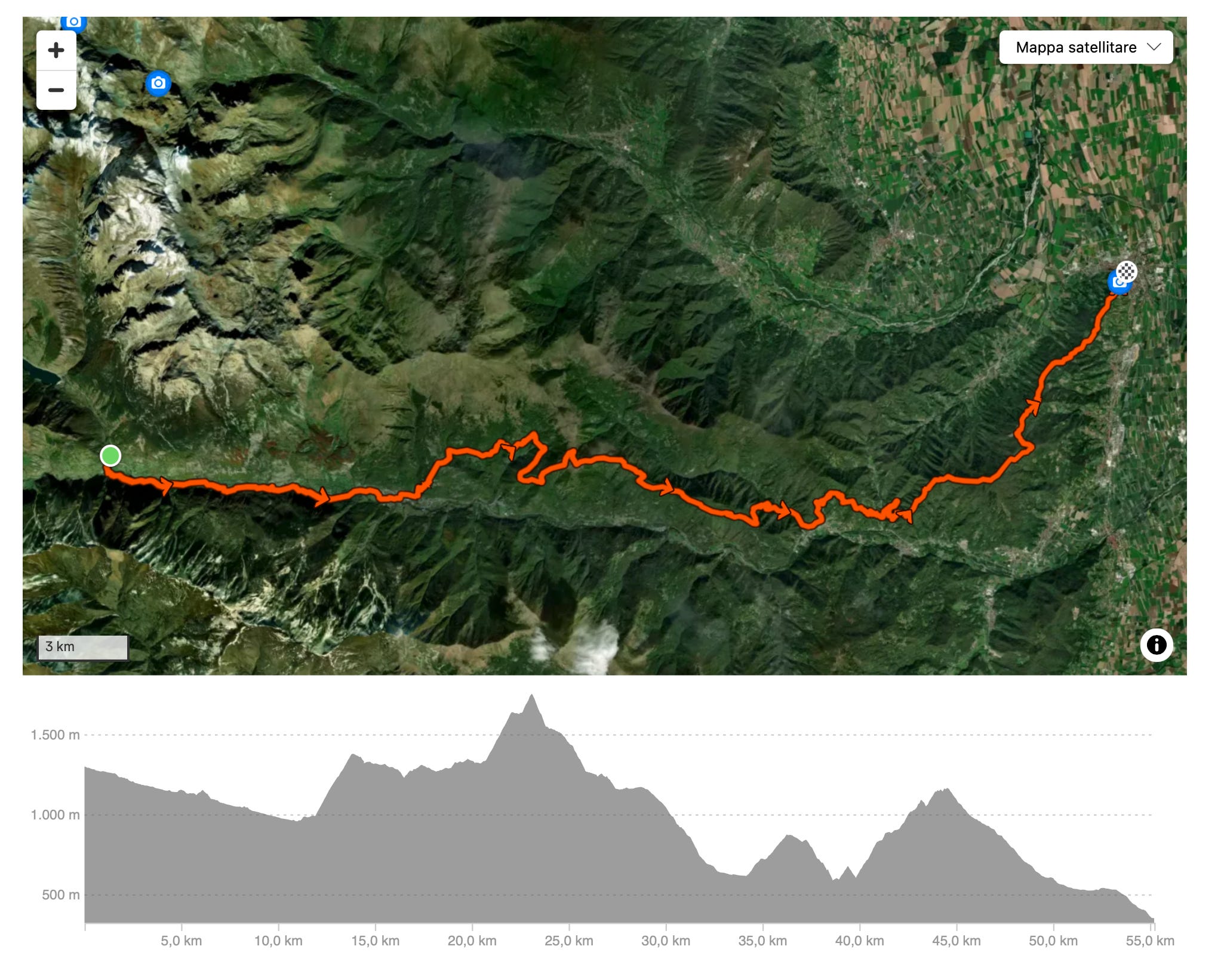
Like a cruel twist of fate, the race comes to collect right after its highest point. One hundred kilometers and fifteen hours in, every part of me wants to stop up in the mountains. But ahead lie sixty more kilometers, dropping straight toward the scorching valley floor.
I sink into a flimsy plastic chair at the aid station, as if it might swallow me whole.
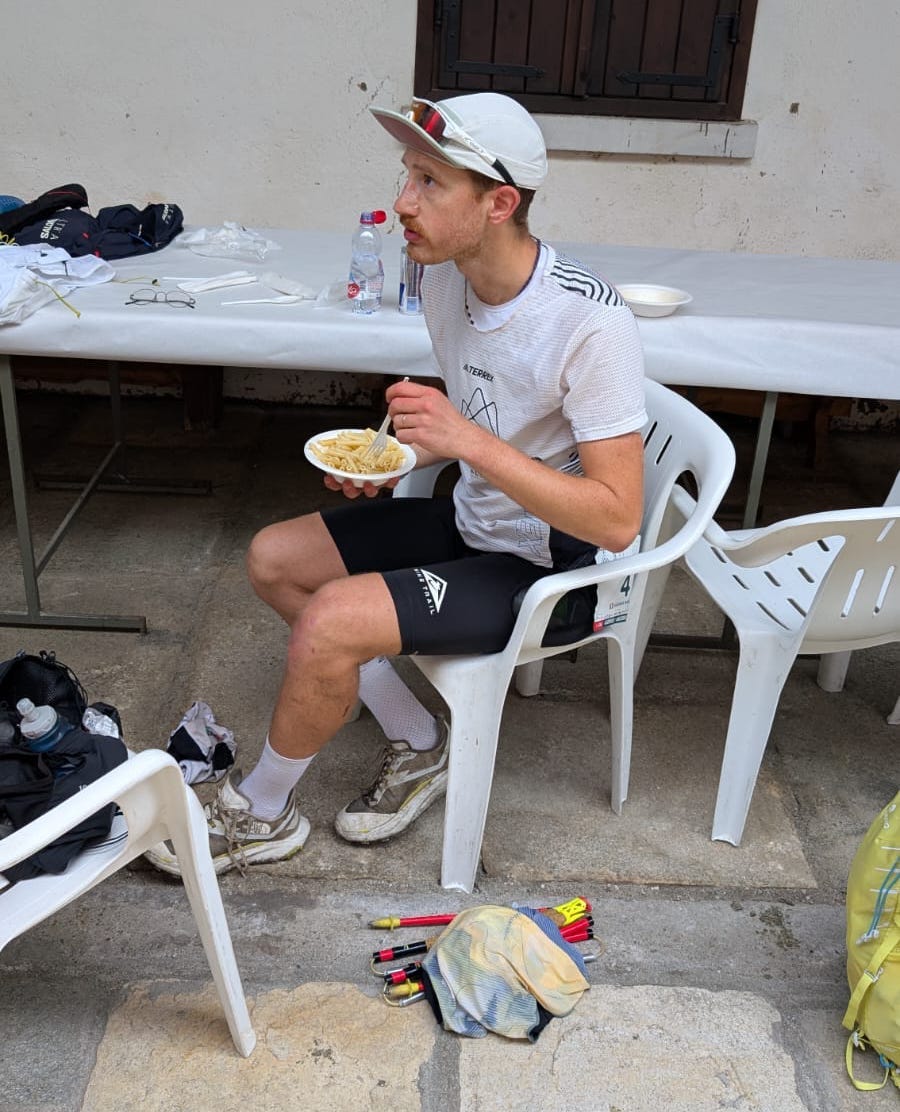
“Pasta and broth on the side, please.” In the end I eat less than half a plate of pasta, but I need it mentally more than physically.
I change socks, swap my shirt and pack, take a quick bathroom break.
I’m ready.
I set off again, now with Piero, convinced I just need to do what it takes to hold my position, with the runner in fourth about thirty minutes ahead.
The stretch from Casteldelfino to Sampeyre passes steadily. The sun is heating up, sweat begins to roll, but the miles keep ticking by. Then it’s the climb to Becetto, followed by the woods up toward Dragoniere and Meira Paula.
Having Piero as a pacer is no small advantage. We’ve trained together for years—he knows me, and he knows these trails. He also knows what it means to run this long; he’s finished several tough ultras himself, and he understands what it feels like when your body rebels, demanding you stop. I know he won’t give me a single chance to quit - right up to the finish he’ll expect everything I have left.
The role of a pacer in races like this is to support where the runner starts to fall short. They can’t run the race for you, but with fresher legs and a clearer head, they help you make better decisions and push through the lows.
The miles roll on. Hours vanish like seconds, while minutes drag on endlessly. Time itself bends and warps.
After so many hours out here, the body starts to economize, and a trained mind narrows its focus to simple, manageable goals, pushing aside anything distracting or destructive. If you aren’t prepared - or if you let cracks appear in the wall of isolation you build - bad thoughts, panic, or despair can slip in and shatter the fragile balance. It’s a mental game before it’s a physical one. That’s why you can feel completely done at hour twelve, full of energy again at hour eighteen, only to crash and rise once more -again and again.
We climb toward Monte Ricordone, and I feel motionless, as if making no progress. But apparently those ahead are no better off: suddenly we realize we’re only 500 meters behind the fourth place runner - Fabrizio, bib number 1, the favorite we’d been chasing all day. He reached Casteldelfino forty minutes ahead of us, but he must have taken a hit from a leg problem that’s slowed him down.
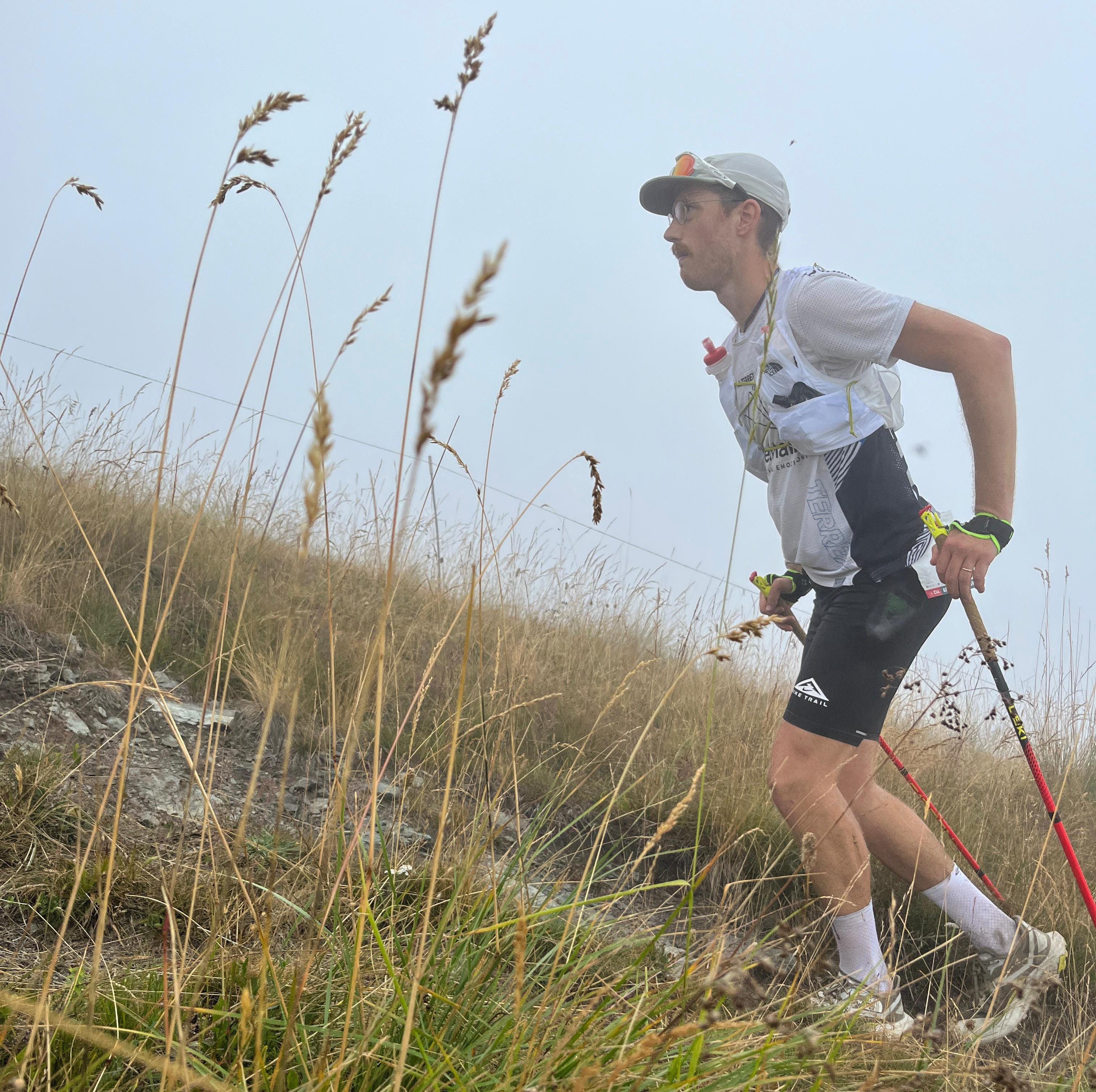
Now I’m in third place, with Piero pulling at the front. Mattia stays right behind, still running my race, even if it means waiting for me on the climbs where I’m struggling most. He’s starting to get restless about the runners chasing us, but he prefers to stick with the two of us - guys who know this terrain inside out.
The descent toward Brossasco is pure madness: we’re flying, like it’s mile one, trying to open as much of a gap as possible on Bongioanni and on Schilt—the Swiss runner who had been in second all day. We overtake him just before leaving the trail for the stretch of asphalt that leads into town. He looks wrecked - but honestly, who doesn’t at this point? He ran a textbook race, shadowing Barnes, holding onto second for hours, but we bombed the downhill too fast for him to hold us off.
We blaze through the aid station in less than a minute. The roar of the Podistica club hits us like a wall of sound - they probably didn’t expect this kind of frenzy in the final kilometers of a ultra trail race. Bottles filled, shouts in our ears, and we’re gone again.
We relax for a few minutes, confident we’ve done some damage behind us.
Then the next miles turn into pure hell. My legs are shot on the climbs, and even though I find some rhythm downhill, I can’t force the pace to keep it sharp. The heat dries my mouth, eating is a struggle, I drink everything I can find along the course - sparkling water whenever I’m lucky enough.
It’s a new sensation. I’m not sick - apart from the dull, grinding ache that’s been gnawing at me since mile 60 - but my body simply refuses to go any faster. My mind, though, wants nothing but to launch for the finish, so close I can almost smell it in the air.
As the finish line draws nearer, one thought begins to spin endlessly in my head: how do I cross before Mattia? We’ve been side by side for sixteen hours. Neither of us will play dirty. Even if I wanted to push away, I don’t have the energy. We’ve decided it will come down to the last kilometer - but how the hell am I supposed to win this? He’s clearly fresher. There’s no other way to see it.
Negative thoughts flood me.
Why are we still pushing? Is it really necessary? Wouldn’t it make more sense to save it for the final descent? Yes, I am eating, yes, I’m drinking, yes, I’m using the poles!
I answer Piero’s and Mattia’s constant reminders—they’re pushing me to focus, to do every little thing right so we can crest Il Vecchio and leave this cursed climb behind.
San Bernardo Vecchio - the little church on the hill behind home where I built my legs - turns, for a long hour, into my grave. I can’t escape it. It’s like walking on a treadmill pitched at 45°, each step sliding backward just a little.
But nothing lasts forever. We’re finally running toward Santa Cristina. My head clears, my legs stretch again on the descent, but the mind still isn’t there. I want to change gears and break free, to fly, to vanish behind the next turn. I want to do things my body can’t anymore - or maybe my brain refuses to let my body try. I’m running 5:30 pace after 24 hours on course, but it’s not enough. I wish I could dig deeper. Instead, my mind spirals into its vicious loop of doubt when all it should do is keep digging - with acceptance, stubbornness, and joy - like it has so many times before.
The last stretch of trail ends, giving way to the final strip of asphalt. Then cobblestones. Eight hundred meters to go, and Mattia and I finally make our move: from La Castiglia to the finish arch it’s all downhill - stone steps, tight turns, hairpin corners. My legs know every meter of this path, rehearsed countless winter nights with the team. That memory helps me cling to Mattia, sometimes even inch ahead. But on the straights? I’m not sure. My brain insists he’s got more left.
The final drop past the Silvio Pellico statue—then 100 meters of straightaway, packed with cheering crowds. I miss the entrance to the barricades, lose precious seconds.
Back in, Piero yelling at my side, Mattia five meters ahead. Then six. Then seven.
I glance over - Piero is screaming something through the deafening roar.
“Go get him! GO!”
I hit the line and collapse. Laughing. What the hell did we just do?
The crowd’s screaming, the announcer going insane at the sprint finish. Mattia grabs my arm, hauls me up—we’ve got the official photos to take.
Bravo, Mattia. You won.
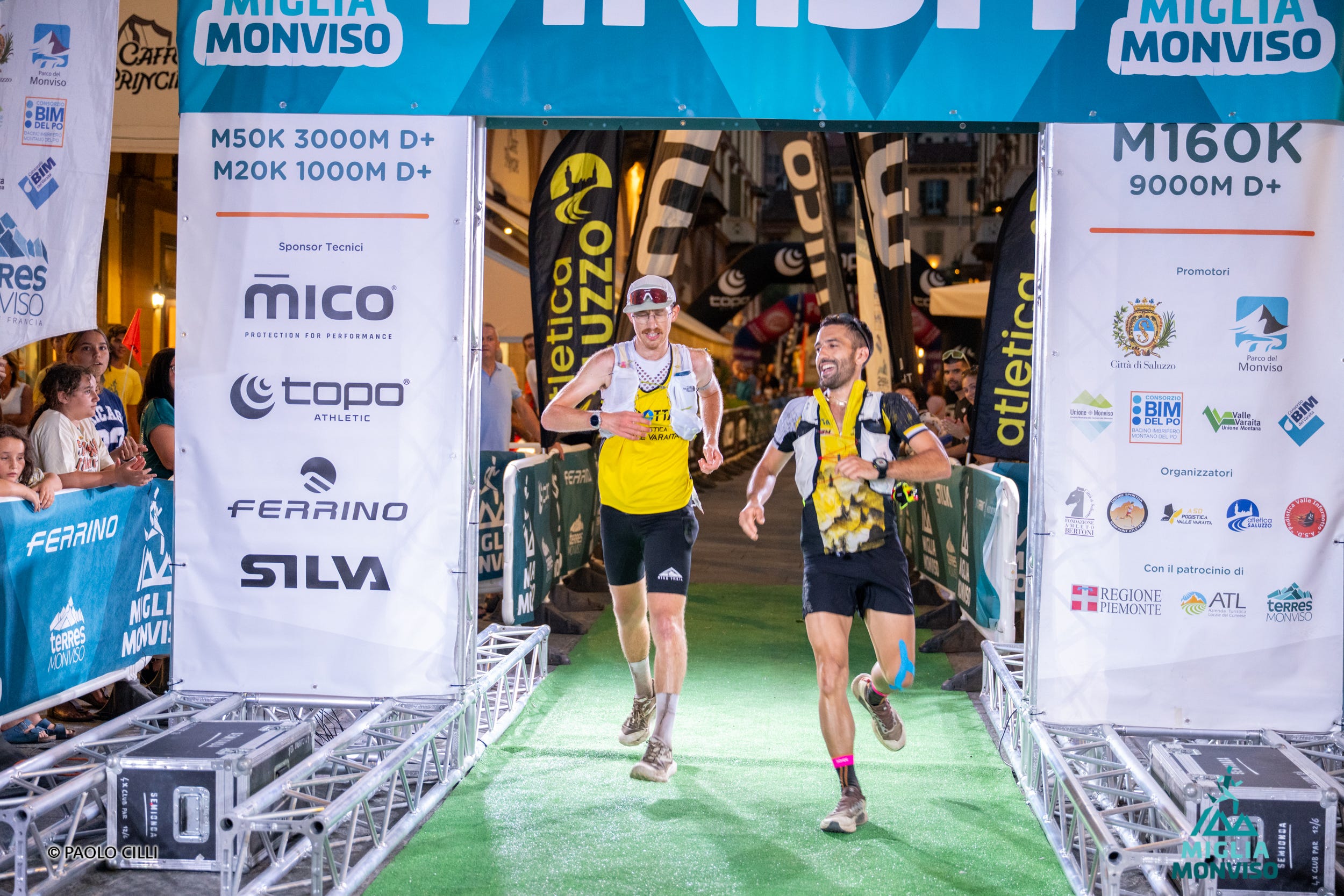
Adrenaline fades and I collapse against a table, then end up on a cot, shivering, gagging - paying the price for that final sprint.
A never-ending line of people to greet, to congratulate, to try to understand. Most of them can’t. If you haven’t lived it, you have no idea. If you haven’t run 100 miles, 160 km, 24 and a half hours, you can’t even begin to comprehend. It’s not about those five seconds behind second place. It’s not about first or second or third. During the race, did you stop? Did you sleep? Did the food come back up? Were you exhausted? Are you sure it’s good for you? I don’t even travel this far by car.
It’s none of that.
It’s life, in a single day.
