
Ease off or push through
August 18-24th 2025 | off-season

Here we are with the first post translated into English from my running diary. I decided to start with the last two weeks of off-season. In September I’ll begin the training block for the marathon I plan to run in the fall, and it felt like the right moment to start sharing. Sorry to say you’ll find me spending two weeks at the seaside and then back on the flatlands training for a road marathon — but it’s just the beginning of a longer journey.
As a paid member, you’ll get access to the full details of all my workouts at the end of each post.
I’ve been turning it over in my head all week. Ease off or push through. I say it often: all those voices telling us to recover, to let the body absorb the work, sometimes make us forget an essential piece of the puzzle. They hide it behind a wall of numbers, evidence, logic. The mind is always there, playing a crucial role in the whole affair—beyond physiology, or maybe shaping physiology itself.
Since I’m not a winner (if the metric is race victories, I’ve never actually won one), I’ve always doubted my own convictions. But when you hear Rod Farvard (and Courtney Dauwalter, and Katie Schide, and François D’Haene) echo the same principle, you give yourself a little pat on the back.
The principle is simple: bypass the central governor. In other words, stop those little voices in your head from convincing you that something can’t be done.
To double up on Western States and UTMB, or Hardrock and UTMB—or go for the full triple—you have to be convinced, in a world that tells you otherwise, that it is possible to make everything fit: train to win the first race (meaning give it everything, prepare yourself to actually compete for victory, which is no small thing even for the champions above), recover, and immediately get back to work for a second shot at glory. In a world shouting the opposite—where hyper-specialization makes back-to-back wins at something like WSER and UTMB increasingly improbable—they try anyway. That mindset is often the difference between being a good athlete and being truly world-class.
It takes some of that too for Ludovic Pommeret, who won Hardrock twice in a row on the eve of his 50th birthday, and now throws himself into the UTMB arena against wolves ten, twenty years younger. And though everything seems to come naturally to him, you can bet Kilian Jornet has a fair share of it as well.
I’m trying to hold on. Coming back from the trek in Valle d’Aosta, I decided not to break the rhythm and to keep the volume high for a few more days, trying to turn all that vertical base into horizontal movement—looking for some efficiency in projecting myself forward instead of upward. As expected, the feedback is mixed: excellent aerobic capacity and volume management (I ran 87 km in three days), but poor efficiency (I generally felt uncoordinated and struggled to find a smooth rhythm), middling sensations, and a higher heart rate than usual (maybe the lingering cold, maybe the stress of returning from travel, or maybe just the lack of efficiency running on flat terrain). At the end of the week, we head out again—this time to Tuscany.
The WEEK
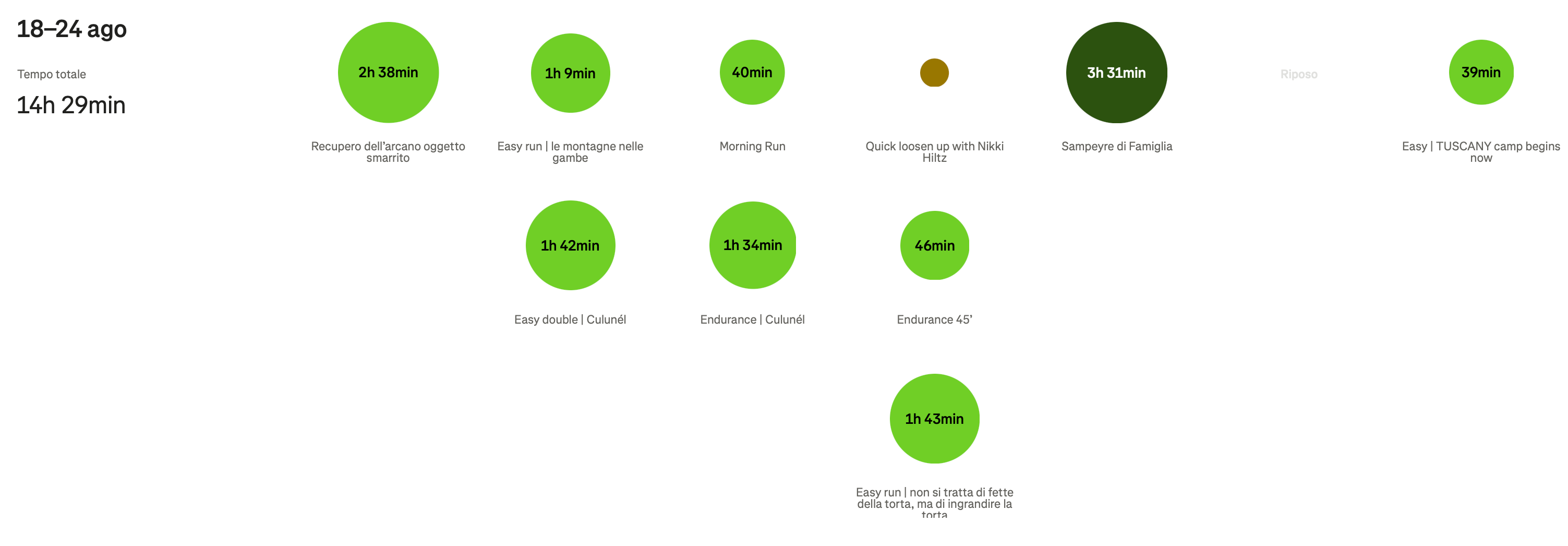
14h30’ moving
106km running
2.600m d+
A bit of mobility
Overall, I’m happy with the work I’ve done — a solid attempt to keep my aerobic capacity high while trying to find back some efficiency on the flats.
Andrea
I love running, cycling when I’m too tired to run, and skiing whenever there’s snow. I enjoy telling stories through video — and of course, through writing.
Co-Founder @vidueo
linktr.ee/andreabarravm
Below you’ll find the full breakdown of all my workouts — for the data nerds out there.
